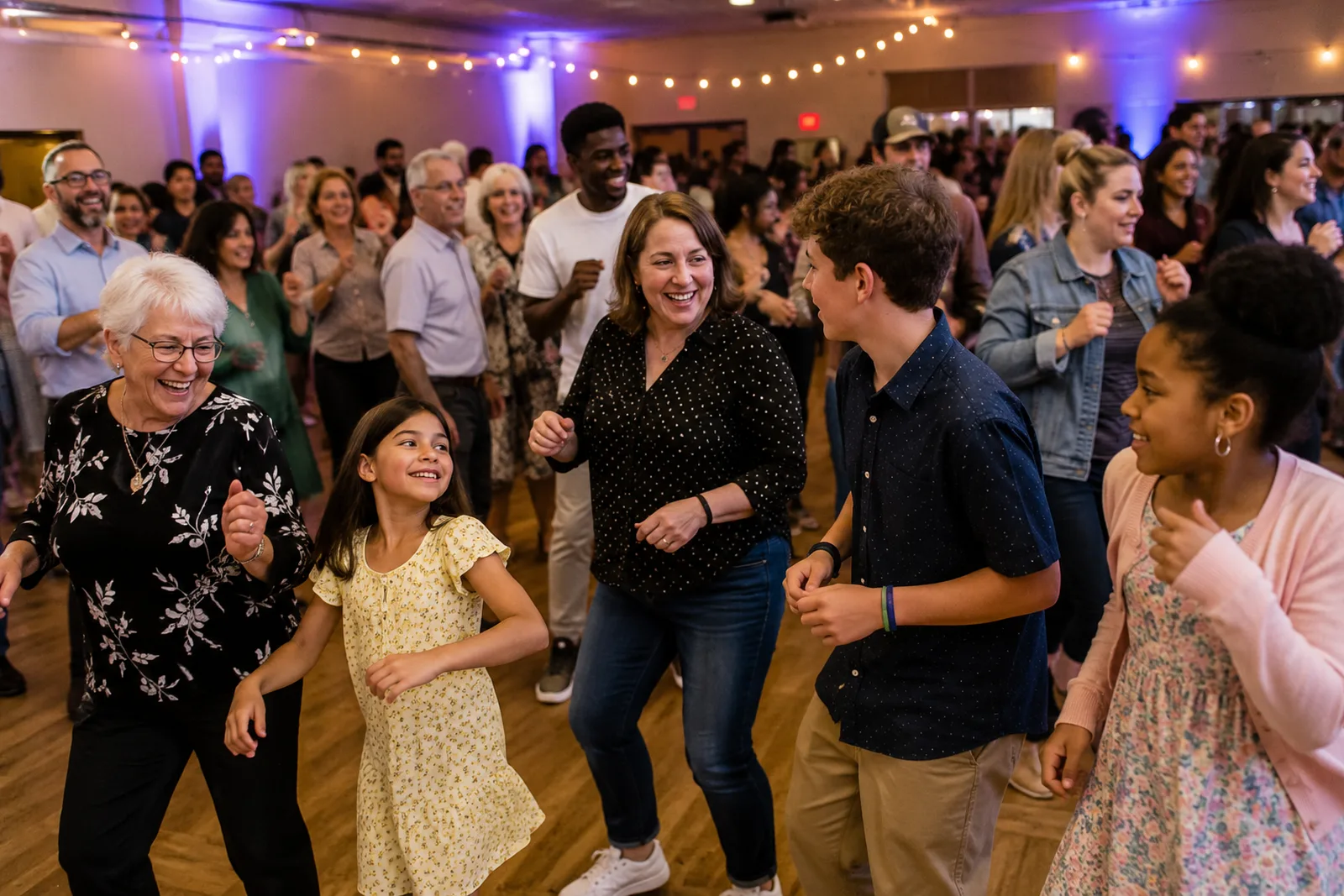
Some songs only need a few seconds. The opening starts, people recognize what's coming, and suddenly they're heading toward the dance floor.
Sometimes they know every step. Sometimes they watch the people around them. And sometimes they don't really know the dance at all. They come out anyway.
After years of watching dance floors, that's one of the things that continues to fascinate us. Music changes. Generations change. What people consider popular changes. Yet some dances refuse to disappear.
Some Songs Become Something More
Cha Cha Slide is more than 25 years old. Cupid Shuffle has been around for about two decades. Wobble isn't exactly new anymore either. And they still get a reaction.
Cha Cha Slide has an obvious advantage. The instructions are right there in the song. Someone who has never done it before can watch the people around them, listen, and start figuring it out. Cupid Shuffle has a simple pattern that people have continued passing along.
Wobble is particularly interesting. We're beginning to see more people who don't seem to know the entire dance anymore, but that doesn't necessarily stop them. The song comes on, and they recognize that this is something people do together, so they head onto the floor and try. Perfect execution isn't required. Participation is.
Long Before the Cha Cha Slide
Of course, none of this started with the dances we think of today. The Hokey Pokey was getting groups of people moving together long before today's wedding couples were born. So was the Limbo.
Those are especially interesting because we've watched them cross generations ourselves. The Limbo was something we remember doing on roller skates years ago. Another generation was still doing it at skating rinks in the late 2000s and into the 2010s.
At a few Special Olympics dances we've been part of, the Limbo has brought people out to take their turn, and the Hokey Pokey has gotten a response too.
Neither requires somebody to walk into the room already knowing a complicated dance. Watch what everyone else is doing, listen to the instructions, and you're part of it. Maybe that's part of their staying power.
Sometimes the Dance Outlives the Song
The Locomotion gives us another interesting example. People don't necessarily need The Loco-Motion playing anymore to form a train. Give the right crowd another song that fits, somebody gets behind somebody else, another person joins, and off they go.
The activity escaped the recording.
The Conga can work the same way. At the right celebration, once the line begins, other people understand the invitation.
Then there's The Twist. More than six decades after that dance became a phenomenon, people still know what it means to twist. There isn't much to learn. Somebody starts moving and another person can join them. Some dances make themselves very easy to inherit.
And Sometimes the Song Survives Without the Dance
We've watched the opposite happen too. In the 1990s, we remember people doing a line dance to a dance remix of December, 1963 (Oh, What a Night). The remix gave the familiar song a beat that worked especially well with the dance, and for a time, people knew exactly what to do when they heard it.
Today, Oh, What a Night is still instantly recognizable. The line dance isn't.
At polka parties during the 1980s and into the early 1990s, we remember groups doing a line dance to New York, New York. People knew the dance and joined in. Today, the song remains familiar, but we rarely see that particular dance anymore.
Then there were traditions that could be incredibly local. While doing middle and high school dances in Montrose, Pennsylvania, we encountered students who had their own line dance for Hot Hot Hot. That crowd knew what to do. Go somewhere else, play the same record, and there was no guarantee anybody would do the same thing.
That's when a dance becomes more than choreography. It belongs to a group of people.
Sometimes One Cue Is Enough
Not every participation song has a dance attached to it. Shout dates all the way back to 1959, and people still request it.
When that familiar softer section arrives, people know what's coming. The room gets lower with the music, waits for the build, and comes back up as the energy rises again. More than six decades later, people aren't just listening to it. They're still doing something together.
Low creates another one of those moments for a completely different generation. There isn't a line dance everyone has to learn. The song reaches that familiar moment and people follow along, getting lower together before coming back up and continuing to dance.
Sometimes a song teaches an entire dance. Sometimes it only gives people a cue. And sometimes that's enough.
Thirty Years Later, They're Still Jumping
One of the more entertaining examples today is Jump Around. The song came out in 1992, and school students today still request it.
They weren't there when it was new. Many of their parents probably remember it from when they were younger. But when today's students ask for Jump Around, there isn't much mystery about what they're planning to do. They're going to jump.
A song doesn't necessarily have to carry complicated choreography to create group participation. Sometimes one shared action is enough.
Then There Are the Love-It-or-Hate-It Songs
Not every recognizable participation song works for every crowd. The Macarena can get a very different response depending on the age of the guests and even where in Pennsylvania we're working.
Apache (Jump On It) can be huge with one group and unwanted by another. And then there's Gangnam Style.
That one can be especially funny. Some people absolutely don't want it. Then somebody requests it, gets onto the floor, starts doing that unmistakable dance and is clearly having the time of their life.
Who's right? The person having fun probably isn't thinking about it.
Is It Cheesy If They're Having Fun?
DJs sometimes talk about avoiding “cheesy” music. We understand the idea. Nobody wants to turn every celebration into a predictable checklist of novelty songs.
But years of watching real dance floors have taught us something else. Certain people respond to certain songs.
YMCA is a perfect example. Play it for the wrong crowd and it may be exactly the record they didn't want. Play it for the right one and arms start forming letters all over the room.
Cotton Eye Joe can do it. The Electric Slide can do it. The Chicken Dance can even do it with the right people.
The song hasn't suddenly become cooler because people are participating. It was simply right for them.
The Crowd Gets a Vote
That's probably the biggest lesson in all of this. There isn't a list of participation dances that belongs at every celebration. There shouldn't be.
Culture matters. Generation matters. Geography can matter. Family traditions matter.
Polkas can fill a floor when they mean something to the people in the room. With another crowd, they may not make sense at all.
The Hora has a very different meaning at a mitzvah than a participation dance somebody learned at a school dance. Even within Pennsylvania, we've watched the same songs get completely different reactions.
That's why reading a room matters.
A DJ doesn't have to personally love a song to understand what it means to the people standing in front of them. And a DJ doesn't have to play something simply because it's considered a classic.
Maybe That's Why They Survive
Perhaps the dances that last aren't necessarily the coolest or most sophisticated. They're the ones people can pass along.
Someone teaches the Electric Slide to someone else. A person who doesn't know the Cupid Shuffle watches the people beside them. The Cha Cha Slide gives its own instructions. Someone ducks under a Limbo pole and the next person understands immediately. A child learns the Hokey Pokey by doing it with everyone else.
A room hears Shout and knows when to go down. Another generation hears Low and follows the cue. And a room full of students hears a song from 1992 and starts jumping.
Other dances disappear because eventually nobody remembers what comes next. The recording survives. The people who knew the dance move on. And one day the song plays without anybody realizing there was once something everyone used to do when they heard it.
Maybe that's the difference.
Some songs survive because people still love hearing them.
Some dances survive because people still love doing something together.